


KinderGarden
FRANCHISE NETWORK HOME DAY CARE CENTERS
FRANCHISE NETWORK HOME DAY CARE CENTERS
KinderGarden
FRANCHISE NETWORK OF HOME KINDERGARTENS

ABOUT US
We create gardens with a sensitive, homely atmosphere where every child is valuable and significant! And let the parents be calm, their baby will take the first steps in learning about the world around them and themselves freely and confidently!
Founders
ALINA NOVOZHILOVA AND EKATERINA PUGACHEVA
Our mission is to help women integrate into a new life and become independent. For women just like us, we are looking for an opportunity to gain financial stability and realise ourselves in a business that has a huge social significance! We have many years of successful experience in running daycare centres. We know how important it is to create an environment where children can grow up happy and confident and parents feel supported! Our goal is to create a community of inspired women! A happy childhood is the foundation for a better life, and a happy mum is an example for a child.

OUR ADVANTAGES
Ease of adaptation
Our cozy home atmosphere allows you to feel confident, gently integrate into the children’s team and get used to your new surroundings.
Friendly atmosphere
In a small team, we maintain a trusting atmosphere where kids learn to be friends, communicate and understand each other

Freedom of expression
Even shy kids in small groups feel comfortable to open up and express themselves, to show themselves by participating in common games and festivities games and holidays, of which we have nine throughout the year
Flexible visiting conditions
Our format allows us to have flexible gardening arrangements for families of all needs, including the option of one-off visits subject to availability

Quality assurance
Our years of experience and reputation in early childhood education and depth of knowledge about child development guarantee – you get the best!
Effective pastime
Minimal distractions give us the opportunity to spend a rich and productive time with the children in the garden

Ease of adaptation
Our cozy home atmosphere allows you to feel confident, gently integrate into the children’s team and get used to your new surroundings.
Friendly atmosphere
In a small team, we maintain a trusting atmosphere where kids learn to be friends, communicate and understand each other
Freedom of expression
even shy kids in small groups feel comfortable to open up and express themselves, to show themselves by participating in common games and festivities games and holidays, of which we have nine throughout the year
Effective pastime
minimal distractions give us the opportunity to spend a rich and productive time with the children in the garden
Flexible visiting conditions
Our format allows us to have flexible gardening arrangements for families of all needs, including the option of one-off visits subject to availability
Quality assurance
our years of experience and reputation in early childhood education and depth of knowledge about child development guarantee – you get the best!
Ease of adaptation
our cosy, homely atmosphere allows you to feel confident, gently integrate into the children’s team and get used to your new surroundings
Freedom of expression
even shy children in small groups feel comfortable to open up and express themselves, to show themselves by participating in common games and holidays, of which we have 9 during the year

Friendly atmosphere
in a small team, we maintain a trusting atmosphere in which children learn to be friends, socialise and understand each other
Flexible terms of attendance
our format allows us to have flexible gardening arrangements for families with all needs, including the option of one-off visits subject to availability
Quality assurance
our many years of experience and reputation in pre-school education and depth of knowledge about child development guarantee – you get the best!
Effective pastime
The minimal distractions allow us to spend with the children in the garden in an enriching productively
LIFE IN THE GARDEN
Age of children: 1.5 to 3.5 or 3 to 7 years old
MULTI-AGE GROUP - FOR NATURAL AND HEALTHY SOCIALIZATION FOR YOUR LITTLE ONE

In our kindergartens, children of different ages learn to support and care for each other. The older children become role models for the younger ones, who learn new skills faster by watching them. This friendly and tolerant environment develops empathy and teaches how to socialize like in real life.
Find out more about the ages of the children and group sizes on each garden’s website – let your child grow up in an environment where they are always cared for.
We use the Waldorf element ‘rhythm’, a gentle and deliberate structure that makes a child’s day clear and predictable.
In babies’ lives, rhythm is not just a schedule, but a way of feeling calm and confident while waiting for familiar and favourite activities. Every morning, every transition from playtime to lunchtime, from a walk
to rest has its own rhythm, which helps children to switch smoothly between activities.
This approach gives the child a sense of order and stability, a sense of security and inner harmony.
and inner harmony. Gradually, the rhythm teaches children to understand their time and space, to listen to their needs, and to find a balance between activities.
their needs and find a balance between activity and rest. Rhythm in our garden is the basis for a good and fulfilling day, where every moment is lived with pleasure and developmental benefits.

We use the Waldorf element of “rhythm”, a gentle and deliberate structure that makes a child’s day clear and predictable.
In babies’ lives, rhythm is not just a schedule, but a way to feel calm and secure in the expectation of familiar and favorite activities. Every morning, every transition from playtime to lunchtime, from playtime to lunchtime.
to rest has its own rhythm, which helps children switch smoothly between activities.
This approach gives the child a sense of order and stability, a sense of security and inner harmony.
and inner harmony. Gradually, the rhythm teaches children to understand their time and space, to listen to their needs, and to find a balance between activities.
their needs and find a balance between activity and rest. Rhythm in our garden is the basis for a good and fulfilling day, where every moment is lived with pleasure and developmental benefit.
RHYTHM OF THE DAY
8:00 – Reception of children
8:15 – Greeting, fingerplays and circle games
8:30 – Breakfast
8:50 – Free play, rhythm of the week activity
9:50 – Cleaning up the playroom
10:00 – Fruit snack
10:15 – Walk
11:30 – Storytelling
11:45 – Lunch
12:15 – Afternoon nap
14:30 – Wake up
14:45 – Finger games and rule games
15:00 – Afternoon snack
15:30 – Board games, workshop, free play, extra activities, outing
17:00 – Finishing work, going home
WEEKLY RHYTHM
The week is structured rhythmically:
Each day is characterised by a different activity, creating the distinctive individual character of each day.
Monday – Painting
Tuesday – Wax modelling, wax fairy tale
Wednesday – Music class
Thursday – Baking
Friday – Homework
RHYTHM OF THE YEAR
The annual rhythm is the basis for the life of our kindergarten. Each month is dedicated to a special theme (epoch), which permeates all the activities of the group, manifested in games, fairy tales and crafts. This helps to give meaning to the child’s activities: he/she does not just play and make crafts, but prepares with friends for a holiday, to which parents will come at the end of the epoch.
September – The Harvest Era
October – The Age of Michael. Dedicated to the heavenly warrior who defeats evil.
November – The Age of Gnomes and the Feast of Lanterns
December – Christmas
January – Christmas Eve. Winter Era
February – Shrovetide
March – Spring Meetings and Birdsongs
April – Easter Era
May – Meeting of Summer. May Garden
June
July – The Age of Summer
August
We use the Waldorf element of “rhythm”, a gentle and deliberate structure that makes a child’s day clear and predictable.
In babies’ lives, rhythm is not just a schedule, but a way to feel calm and secure in the expectation of familiar and favorite activities. Every morning, every transition from playtime to lunchtime, from playtime to lunchtime to rest has its own rhythm, which helps children switch smoothly between activities. This approach gives the child a sense of order and stability, a sense of security and inner harmony and inner harmony. Gradually, the rhythm teaches children to understand their time and space, to listen to their needs, and to find a balance between activities.
their needs and find a balance between activity and rest. Rhythm in our garden is the basis for a good and fulfilling day, where every moment is lived with pleasure and developmental benefit.
RHYTHM OF THE DAY
8:00 – Reception of children
8:15 – Greeting, fingerplays and circle games
8:30 – Breakfast
8:50 – Free play, rhythm of the week activity
9:50 – Cleaning up the playroom
10:00 – Fruit snack
10:15 – Walk
11:30 – Storytelling
11:45 – Lunch
12:15 – Afternoon nap
14:30 – Wake up
14:45 – Finger games and rule games
15:00 – Afternoon snack
15:30 – Board games, workshop, free play, extra activities, outing
17:00 – Finishing work, going home
WEEKLY RHYTHM
The week is structured rhythmically:
Each day is characterised by a different activity, creating the distinctive individual character of each day.
Monday – Painting
Tuesday – Wax modelling, wax fairy tale
Wednesday – Music class
Thursday – Baking
Friday – Homework
RHYTHM OF THE YEAR
The annual rhythm is the basis for the life of our kindergarten. Each month is dedicated to a special theme (epoch), which permeates all the activities of the group, manifested in games, fairy tales and crafts. This helps to give meaning to the child’s activities: he/she does not just play and make crafts, but prepares with friends for a holiday, to which parents will come at the end of the epoch.
September – The Harvest Era
October – The Age of Michael. Dedicated to the heavenly warrior who defeats evil.
November – The Age of Gnomes and the Feast of Lanterns
December – Christmas
January – Christmas Eve. Winter Era
February – Shrovetide
March – Spring Meetings and Birdsongs
April – Easter Era
May – Meeting of Summer. May Garden
June
July – The Age of Summer
August
8:00 • Reception of children
8:15 • Greeting, fingerplays and circle games
8:30 • Breakfast
8:50 • Free play, rhythm of the week activity
9:50 • Cleaning up the playroom
10:00 • Fruit snack
10:15 • Walk
11:30 • Storytelling
11:45 • Lunch
12:15 • Afternoon nap
14:30 • Wake up
14:45 • Finger games and rule games
15:00 • Afternoon snack
15:30 • Board games, workshop, free play, extra activities,
outing
17:00 • Finishing work, going home
The week is structured rhythmically:
Each day is characterized by a different activity, creating a distinctive individual character for each day.
Monday – Painting
Tuesday – Wax sculpting, wax fairy tale
Wednesday – Music class
Thursday – Baking
Friday – Homework
The annual rhythm is the basis for the life of our kindergarten. Each month is dedicated to a special theme (epoch), which permeates all the activities of the group, manifested in games, fairy tales and crafts. This helps to give meaning to the child’s activities: he/she does not just play and make crafts, but prepares with friends for a holiday, to which parents will come at the end of the epoch.
September • The Harvest Era
October • The Age of Michael. Dedicated to the heavenly warrior who defeats evil.
November • The Age of Gnomes and the Feast of Lanterns
December • Christmas
January • Christmas Eve. Winter Era
February • Shrovetide
March • Spring Meetings and Birdsongs
April • Easter Era
May • Meeting of Summer. May Garden
June
July • The Age of Summer
August
METHODS
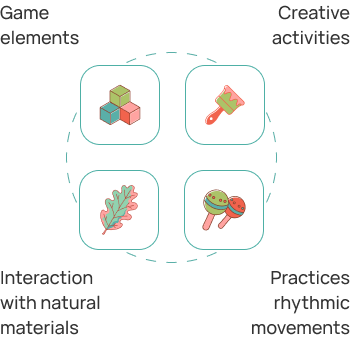
Playful elements, rhythmic movement practices, creative activities and interaction with natural materials, which we have taken from the Waldorf method, help to develop fine motor skills, movement coordination and sensory perception – as real corrective neuropsychological exercises.
These processes have a beneficial effect on the formation of neural connections and contribute to better perception, memory and attention. When children sing, play rhythmic games, do simple crafts or work with natural materials, they are not just enjoying the moment – they are developing essential neuropsychological skills that help them to be more confident, attentive and emotionally resilient.
METHODS
These processes are beneficial for the formation of neural connections and contribute to better perception, memory and attention.
When children sing, play rhythmic games, do simple crafts or work with natural materials, they are not just enjoying the moment – they are developing crucial neuropsychological skills. with natural materials, they’re not just enjoying the moment – they’re developing crucial neuropsychological skills,
which helps them to be more confident, attentive and emotionally resilient.
Playful elements, rhythmic movement practices, creative activities and interaction with natural materials, taken from the Waldorf method and interaction with natural materials from the Waldorf method help to develop fine motor skills, motor coordination and sensory perception – as real corrective neuropsychological
exercises.
BOOK A TOUR

TEAM
Our team are people who genuinely love children and know how to find an approach to them, support them and help them develop. We carefully select franchisees and their employees to create a caring and safe environment for children. We provide special training for caregivers and aides so they can interact effectively with children, maintain respectful boundaries, resolve conflicts, and accommodate each child’s individual differences.
It is important to us that the kindergarten is a second home for the children, where they are surrounded by understanding and trustworthy adults who are ready to support and help in any situation.

Alina Novozhilova
Co-founder of KinderGarden, Domzhale
…

Ekaterina Pugacheva
Co-founder of KinderGarden, Ljubljana

Nikolay Novozhilov
Co-founder of KinderGarden, Domzhale
…
WE ARE RECOMMENDED
”
”
BOOK A CONSULTATION
BOOK A CONSULTATION
Didn't find a suitable garden on the map?